Grok Build vs Codex CLI vs Claude Code: what actually differs for a working agency
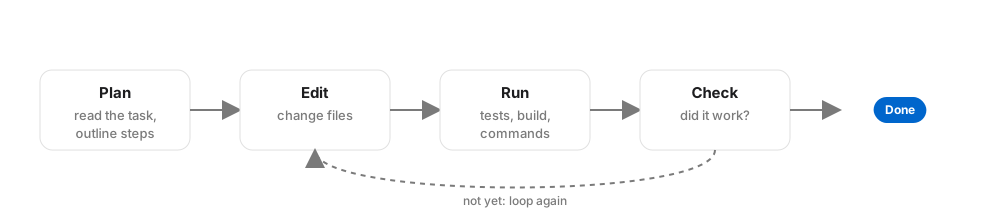
Three terminal coding agents now compete for the same job: describe an outcome, let the agent plan, edit files, run commands and iterate until it is done. Claude Code from Anthropic, Codex CLI from OpenAI, and the newest, Grok Build from xAI, which launched in beta on 14 May 2026. We use Claude Code daily and have run the other two on real tasks. Here is the difference that matters when you are billing hours.
Grok Build
xAI's entry ships with plan mode on by default, native parallel sub-agents (up to eight, each running its own plan-search-build loop), an "Arena" mode that ranks competing outputs before you see them, support for the Agent Coordination Protocol, and a backing model with a 256K-token context window. It launched behind the US$300 a month SuperGrok Heavy tier and opened to the US$30 SuperGrok and X Premium+ tiers within two weeks.
It is fast and the parallelism is genuinely different. It is also early beta. Tooling around it, editor integrations, MCP breadth and stability, is months behind the other two.
Codex CLI
OpenAI's agent is the value pick: it is included in ChatGPT Plus and Pro subscriptions at no extra cost. Its distinct feature in 2026 is a separate built-in review agent that critiques your diff before you commit, and the backing model is natively multimodal. Codex is quick and excellent on boilerplate-heavy work. On long, multi-file production changes it is closer to Claude Code than the benchmark noise suggests, but we see more "looks right, is not" edits.

Claude Code
Anthropic's agent is the one we build our workflow on. The reasons are not the model alone:
- Skills. Small instruction packs the agent loads only when relevant. Ours cover Jira ticket formats, site audits, our design rules and client-specific gotchas. This is how a tool becomes your tool.
- MCP everywhere. Every service we touch, WordPress, Cloudflare, Google Analytics, Jira, connects through MCP and Claude Code treats them as first-class tools.
- Hooks and permissions. Deterministic guardrails: block writes to client sites, require a ticket before a deploy, run a formatter after every edit.
- Sub-agents and plan mode exist here too; they are just not on by default.
On complex codebases and long tasks it is the most reliable of the three. That reliability is what we are paying for.
Benchmarks, briefly
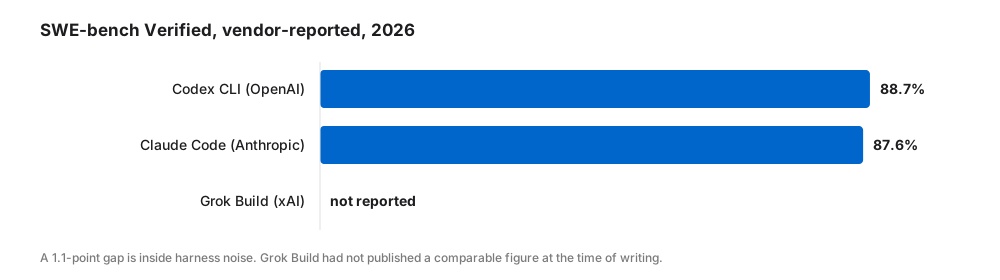
On SWE-bench Verified the vendors report Codex CLI at 88.7 per cent and Claude Code at 87.6 per cent, a gap inside harness noise. Benchmarks measure a solved task once; agency work is the same task across twelve different client stacks with different guardrails. That is where workflow features decide.
Our verdict
| Need | Pick |
|---|---|
| Hard multi-file changes on production code | Claude Code |
| Cheapest capable agent if you already pay OpenAI | Codex CLI |
| Fast boilerplate and scaffolding | Codex CLI |
| Trying parallel agents on greenfield work | Grok Build |
| Deep integration with your own tools and rules | Claude Code |
| Betting a client deadline | Claude Code, not a beta |
Choose the one that fits the ecosystem you already live in, then invest in the skills, hooks and MCP connections around it. The model gap between the three is smaller than the gap between a bare agent and one that knows your business. If you want help building that second kind, talk to us.